11/21/2014

Kis-Balaton

Kis-Balaton belongs to the Balaton Uplands National Park. As its name indicates it is connected to our Hungarian See, the Lake Balaton, however it has natural and strictly protected areas as well. We visited the few open spaces for public.


The Buffalo reserved is really a great place with goats on the play ground and semi-wild water buffalos all around. There is an electric wire which keeps the animal away from the friendly humans visitors. Huge open area with a small entrance fee. 


A narrow trail leads us to the field, where one can come up face to face to all sorts of household mammals (mostly ungulates) and of course some curious buffalos. 


Information boards area available all along the way and not only with Hungarian explanations. This area is packed up with nest boxes and bat boxes and there is a high stand in the middle of the field so it is worth to walk around the whole way. 


This field is ideal for ground squirrels (Spermophilus citellus) so we observed quite a few from a very short distance.


Traditional Hungarian well and its description.


View from the high stand.


This is the gate to enter an other erea which belongs to the Kis-Balaton. This is really the place when we can observe birds as it a protected wetland area. I have seen the common species as usual and a little grebe (Tachybaptus ruficollis). Little cormorants are not rare here but I have only seen the 'big brother' (Phalacrocorax carbo).


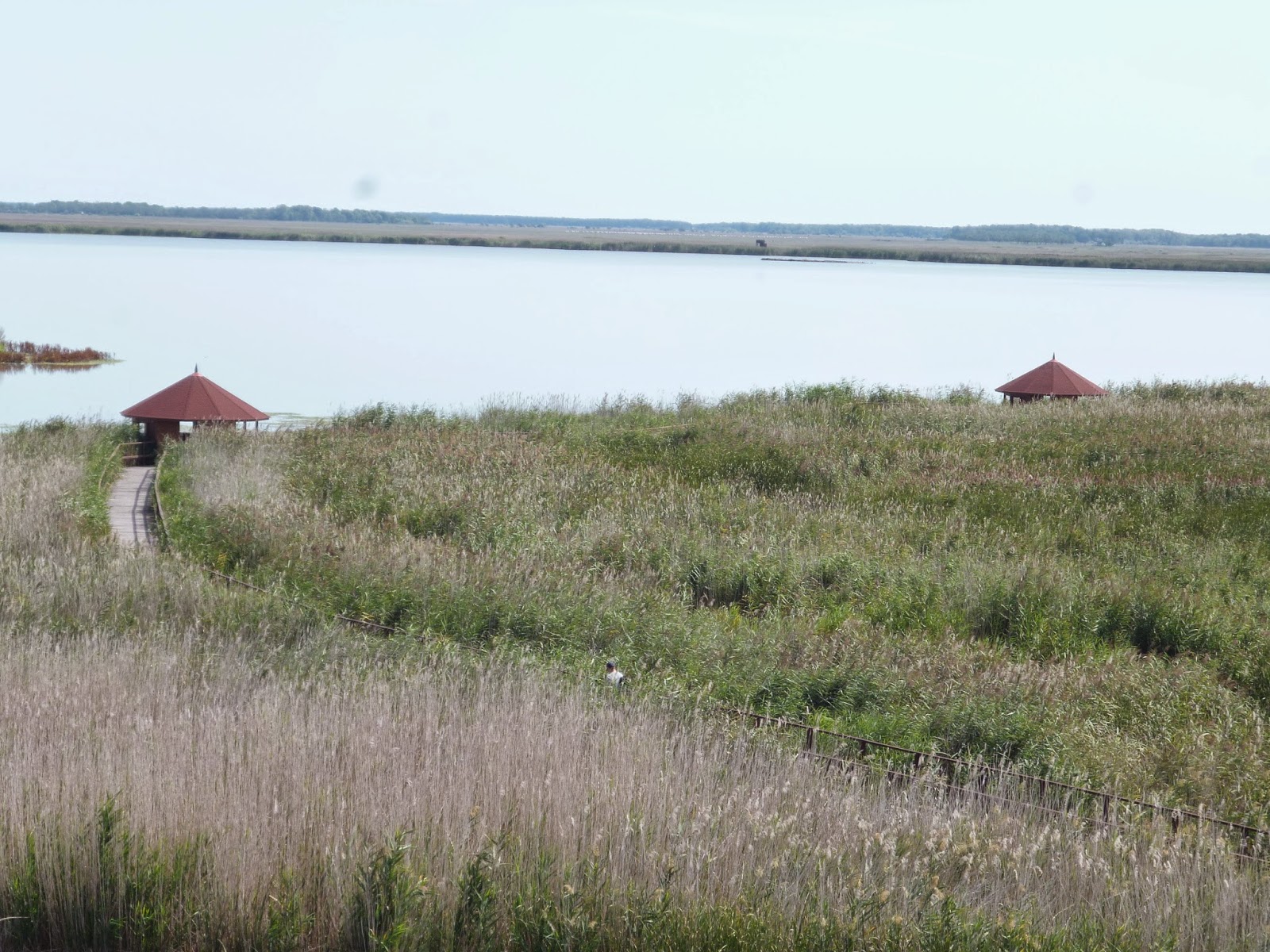
There is a wooden bridge which leads through a channel and brings us to an island. 


Usually there is a small fee for parking but it is rather worth to come here by bike as it is kinda part of the bike trail which runs around the Lake Balaton. 

10/06/2014

Kunkápolnás

After a rainy day, we have arrived to the Kunkápolnás Marsh. I have been here before with the local ranger, who has an extraordinary data collection from here. On the picture below, one can see a rather shaky road, what took us to the nearby village (Nagyiván), where we left the car and wondered around for a short period of time.


At the very edge of the site, there is a museum, where one can have a look, how Hungarian villagers have lived some times ago. The symbol of the Hungarian Great Plain (Puszta) is the "Gémeskút" or as I found via Google; Shadoof.


The site is stricktly protected, so we only looked at it from the peripheric. There was an other group visiting the site, not professional Hungarians, I believe so.


The vegetation is typical for salt marshes.


I have seen only one species but it was quite a good one for me: Stone curlew (Burhinus oedicnemus). See this sime for sound recordings on the species: http://www.lepkek-madarak.hu/content/view/32/10/


9/11/2014

Hortobágyi Halastó

One of the most well known Ramsar area in Hungary is Hortobágy. This time, I visited the Hortobágy Fish Pond district, where I also participated in ringing activity at the international ringing station. It is international because birds fly into the nets from so many countries, just joking, hahaha.


Here you go, a very nice example how an eco-region can function as a tourist attraction. This train station is new and attractive, well kept with a play ground near by. I also saw a note board, where birders can write down where and what have they seen. Information desk and all the necessary facility is available to have a relaxing day in one of the largest national parks of Hungary.


This is the ringing station, where one can volunteer and help out to take the birds out of the net. Ringers with official licence are also welcomed so people could come here from all over the world. 


I had the chance to see a Kingfisher (Alcedo atthis) in hand. Very nice animal with bright blue coloring. The above picture shows a passerine caught with the net and then taken into a cotton bag. Usually it is better to lay them into the pockets of the net, so they can rest while the bird ringing team checks out the whole net. It is crucial to note where and when one exactly found the bird as it is impossible to analyse the data without this information. All the nets have a unique identification number and hourly check ups are regular during migration time.


The station is quite new, not fully equipped but soon it will be. Sleeping places are available at the train station, which is very near (circa 5 minutes on foot)! 
I have found an interesting blog about a ringing station in Israel, if you have time check it out: http://eilatbirding.blogspot.hu/


Immense reed beds cover the area so reed dwelling species can certainly thrive here. I have seen a Bittern (Botaurus stellaris) while passing by with the train. It was very surprised to see us, so frozen without any move, not that it would move if we would have seen him without the pounding noise... Anyway, birds are flying all over the place, and the fields are grazed by semi-wild water buffalo. Eco-friendly that's for sure!


Not all lakes are managed for commercial purposes. Some are only there for nesting and foraging. I do not know much about the fishing activity but I know that the company works together with the national park and for example provides accommodation. There are so many opportunities to stay over for a night as the village called Hortobágy is near by and local people rent out every room they have it unused (see: http://www.hortobagy.hu/turizmus/szallasadok/). 


I took this photo from the train. Apparently there are so many stops during the 20 minutes ride but the train does not stop for the moment. This website (at the moment mainly in Hungarian) explains a lot about the history of the train: http://narrowgauge.hu/view_cikk.php?id=883&rfa=164


Floating vegetation makes the area distinctive and attractive for various species. 


At the last stop the train makes a long pause. One can decide to go back on foot or take the train back. There are observation points in the reed, which are very nicely constructed. Rangers of the national park accompany the passengers and they give a short introduction to the area. After that, it is possible to ask for their advise and use their equipment. 


I have seen the following species: Squacco heron (Ardeola ralloides), Barn swallows (Hirundo rustica) dancing in the air, different ducks feeding on the open water. 


This is how the area looks like with a bird eye. I climbed a pretty high observation tower and took a photo of the area. There are several lakes in a row, lake Kondás is the last one and this is the terminus of the narrow gauge train too.  


Meeting point at the train station.


Some good food source in the village of Hortobágy, where I had my birthday lunch on the 23rd of August. Csárda means 'Inn' and typical at the Hungarian countryside.

8/28/2014

Tisza-tó


This lake is famous of its ecotourism also I heard quite a few foreigners, while we looked around. Tisza is the second largest river in Hungary and its floodplain was huge before the river became regulated. One of the largest and oldest national parks in Hungary is the Hortobágy National Park and the lake is on their territory.


I wouldn't say it is a totally undisturbed area but still it is a heaven for waterbirds. There are organized bird watching tours on the lake with small boats like this on the photo above. The name of the boat is: Madarász, which means ornithologist.
Tour guides are available by several different organizations but one has to pay to go on the lake with them. I would say, the best way is to wonder around is to hire a canoe. 


Wild life is one of the central point of the tourism and so sensitive sites are not open for the public. On the other hand, waterway are busy and powerboats are loud. 


One of the best known Hungarian snack is the Lángos and it was perfect at the buffet of Poroszló.


The lake is also recognized as a tourist attraction and it is possible to have a little swim in it. It was free to enter the beach but this is not the case everywhere around the lake.


Fishing activity is allowed but a ticket must be purchased before shooting our hook in the water!


Highways and motorways are farther on so I wouldn't say it is a major source of disturbance.


Information boards are available almost everywhere around the lake. There are several towns in the proximity of the lake, we only made a stop at Poroszló. The city has all the facility to pack you up for a longer stay, wifi connection is available even in small places like the Lángos Buffet.


I have seen mallards (A. platyrchynchos), black-headed gulls (L. ridibundus) and I thought I've seen a little gull (Hydrocoloeus minutus) but it was most probably whiskered tern (Chlidonias hybrida).
Swans were absent but barn swallows (Hirundo rustica) were flying vividly around.


This young 'fisher-boy', whose chair is vacant on my picture, catched several brown bullheads (Ameiurus nebulosus).


http://www.tiszataviokocentrum.hu/en/


The ecocenter was opened a few years ago and it seems to be success to me. I believe, Hungary could be a place for ecotourism. I took a photo of the entrance fees so one can imagine the prices in Hungary.


That is my last photo of the area. I had a good sight to a juvenile common moorhen (Gallinula chloropus) from this spot.